

First off and totally unrelated to anything having to do with railroads is this:


Northern Lights in Rehoboth Beach, Delaware! This photo was taken in front of our house. (admittedly a while ago) Why go to the far northern reaches of Norway or Canada when one can see this spectacle from the comfort of one’s home? This photograph, with its red and green hues, was taken with an iPhone. The naked eye however did just see a grayish, barely colored haze in the night sky. I understand that it has something to do with the wavelength of light and the amount of light the camera can “catch”. If anybody has a better explanation, please leave it in the comments.
So, back to trains and such…
TRIX, which is a subsidiary of Märklin , just recently released an HO scale model of the “Northlander”:


Photo: TRIX/Märklin GmbH
The “Northlander” was operated by the Ontario Northland Railway until it was discontinued in 2012. The line ran from Toronto to the far north of Ontario, terminating in Cochrane. The railway was and still is owned by the Province of Ontario. The Government of Ontario is planning on reinstating this service in mid-2025 using newly acquired Siemens “Charger” locomotives and “Venture” coaches and cab cars.
In 1977 the Ontario Northland Railway bought four sets of TEE diesel trains from the Dutch and Swiss railways. These trains had been developed by and for the Dutch Railways (NS), as well as the Swiss Railways (SBB) for the TEE rail system in Europe. Swiss Railways classified them as RAm 502, NS classified them as DE 4. A set had a diesel-electric power car, two intermediate cars and a cab car. In 1974 the TEE system changed over to all electric traction and consequently the NS and Swiss Railway retired all four RAm and DE 4 sets. As mentioned, the Ontario Northland bought all four sets in 1977.
The four sets were modified to comply with Canadian railway standards. The trains than ran from Toronto to Timmins. However in 1979 ONR decided to scrap the power cars. The Canadian winters were just too much for the units. In addition, the maintenance crews were not really familiar enough with the European equipment to keep it running in good order. From then on ONR used EMD FP7 locomotives to haul the trains until the service was discontinued.

Ontario Northland FP7 Photo: Marc Dufour
Just a short time ago Trix released the HO scale version of the “Northlander”. The model was only available through advance reservations and then originally only to members of the Trix Club. As is the case so often the model was announced close to a year ago, with delivery in the US set to late 2024. (TRIX is owned by Märklin, as mentioned before. Märklin manufactures the HO three rail AC line of trains, while TRIX makes the HO two rail DC models)
This TRIX HO scale model is a beast: the train is almost all constructed out of metal and the power car alone weighs in at close to two pounds. It comes ex-factory with a decoder/sound. There are a slew of available light functions: head lights, number board lights, classification lights, engine room lights, coach interior lights, etc. There are at least a dozen sound functions, most of which I will most likely never use. While I like most of the functionality of DCC, sound is not one of them. When I run five or six trains on my layout the cacophony of noise is just intolerable to me. A clanking coupler sound? I mean, really?
As one expects of TRIX/Märklin the detail on the model is great. The printing is sharp and the different colors do not bleed into each other. Trucks (bogies) are nicely detailed and the hand rails are separately attached and not part of the body shell mold. 
The power car has two three axle trucks, whereas the coaches have two two axle trucks.


Classification Lights and Number Board on the power unit. Notice that even the hinges on the Number Board box are modeled.
Bell, horn and radio antenna on the power car roof:

The coaches have interior LED lighting, as well as tables and chairs.

The gangway between coaches are nice and fit snuggly, even in tight radius curves:

Power car front:

Cab car front:


The four car set has to be connected exactly according to instructions. Otherwise it will not run. Connections are established via a current conducting coupler system:

I am not a fan of this arrangement. The pins are difficult to line up correctly and tend to bend if not handled with utmost care.
The model runs well. Though I do think that at this price point the power car ought to have a “bridge capacitor” to get over some short powerless track sections. The set is also not breaking any speed records. However I will have to investigate this a bit further since there is a good chance that this can be changed via one of the CVs in the decoder programming.
Another annoying TRIX thing is the inability to program the decoder to give the set its unique address, usually the running number, as shown on the front of the power car. In this case it would be 1981. This actually applies to all my TRIX locomotives. If I want to run any of them I have to use the default factory decoder address which is “3”. I can not figure out if it is an issue with my MRC Advance Prodigy DCC system, or it is an issue with TRIX decoders. I have no problems with any other model train manufacturer at all. Alas the Internet isn’t much help. If anybody has any ideas, please leave a comment.
Another small gripe I have with all TRIX models in my collection is the intensity of the head and tail lights, or rather lack thereof. I just find them way to dim:
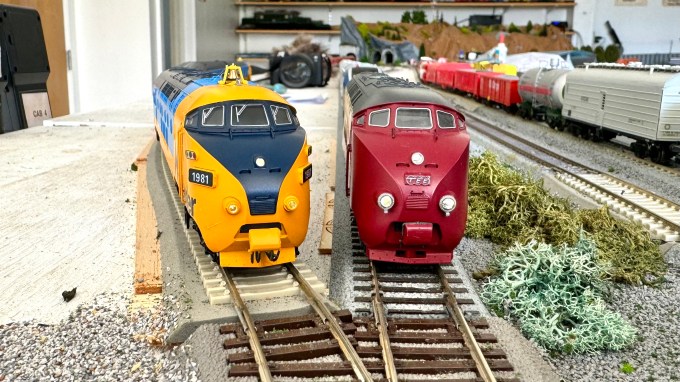

The TRIX model on the left. A Roco model on the right. The Roco model is about twenty years old by now and is a model of the original train ONR eventually purchased.
The model was originally sold only to TRIX Club members. It appears that limited quantities are now for sale, like at Reynauld’s Euro Imports.
All photos by Ralf Meier unless other wise noted (iPhone 16 Plus and Sony RX 100 m7)